


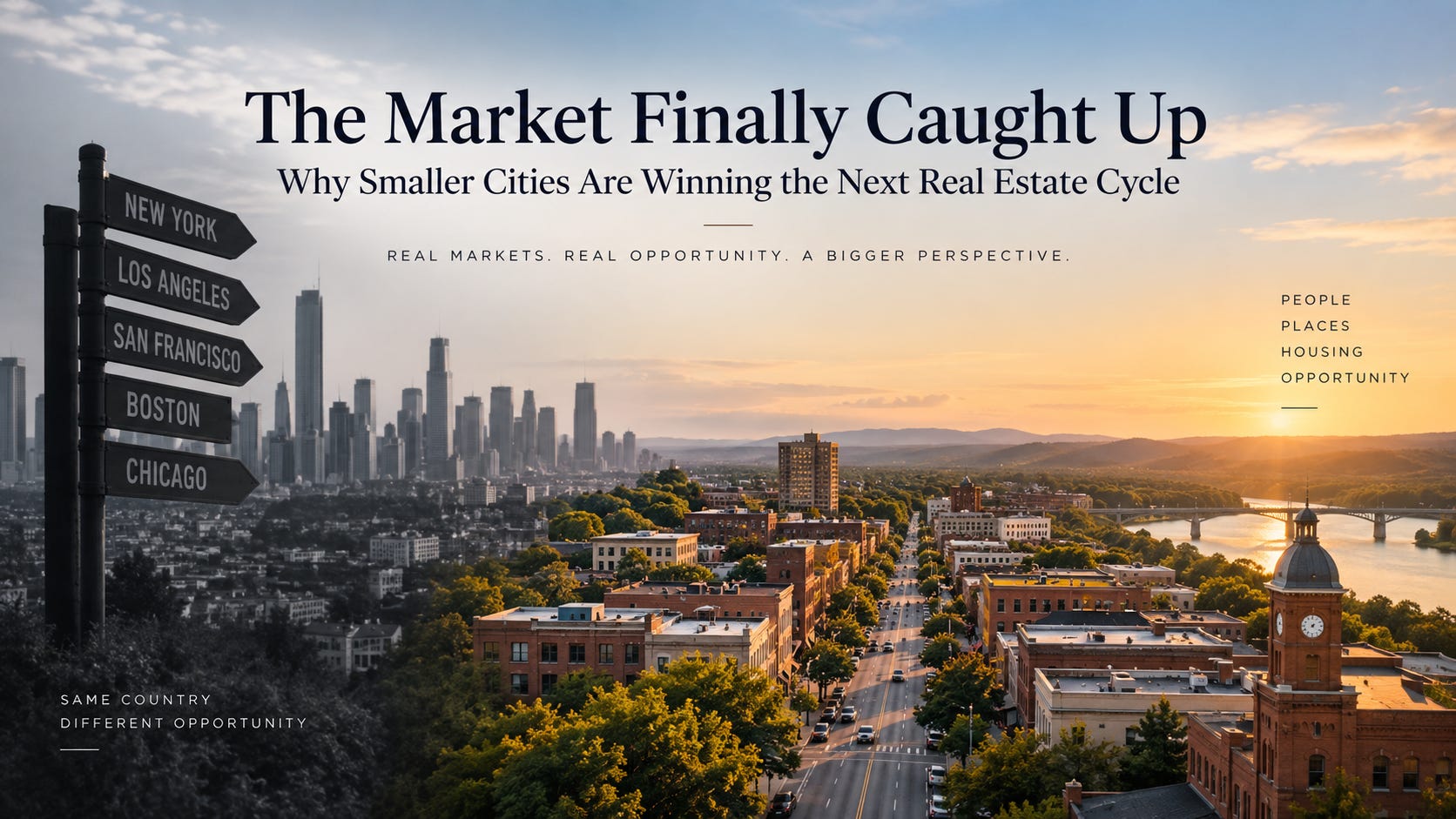
For the better part of five years, our real estate thesis has been pretty simple.
Go smaller.
Smaller cities. Smaller metropolitan areas. Markets where the fundamentals make sense, the basis makes sense, and you are not competing with 30 institutional buyers to buy land at a price that requires everything to go perfectly for the next seven years.
It was not always the fashionable strategy.
For a long time, institutional real estate operated under the assumption that bigger was inherently safer. New York. Los Angeles. San Francisco. Boston. Chicago. Washington.
Big employment base. Deep capital markets. Liquidity. Institutional buyers waiting on the other side.
All of that is true.
But it also comes with expensive land, expensive construction, expensive labor, complicated entitlement environments, compressed yields, and increasingly difficult mathematics.
Meanwhile, we kept looking at places most institutional investors barely had on their maps.
Not because they were cheap.
Cheap real estate is often cheap for a reason.
We were looking for smaller markets where something fundamental was changing.
Population.
Employment.
Infrastructure.
Housing demand.
Employer investment.
Transportation.
Universities.
Healthcare.
Manufacturing.
Technology.
Tourism.
Or simply a chronic mismatch between the housing a community needed and what developers were actually building.
That distinction matters.
We were never betting on small markets simply because they were small.
We were betting on overlooked markets where the underlying economics were becoming better than the perception.
Now the capital markets are beginning to agree.
The Numbers Have Changed
The shift taking place in commercial real estate is much larger than most people realize.
In 2010, primary markets accounted for roughly 46.5 percent of commercial real estate transaction counts across the four major property sectors. Tertiary markets represented approximately 35 percent.
By 2023, tertiary markets had crossed 50 percent.
They have largely stayed there.
Today, primary markets account for only about 34 percent of transaction counts.
Think about that for a minute.
The places that were historically considered the periphery of institutional commercial real estate now represent more transactions than America’s largest markets.
And this is not just apartments.
Since 2017, the tertiary share of office transactions has risen from approximately 39 percent to 48 percent.
Single tenant retail went from roughly 48 percent to 58 percent.
Multi tenant retail increased from about 41 percent to 52 percent.
Industrial moved from approximately 37 percent to 51 percent.
Apartments increased from roughly 28 percent to 40 percent.
In 2010, tertiary markets recorded around 7,700 transactions.
Today that number exceeds 44,000.
That is not noise.
That is a structural change in where American real estate capital is being deployed.
This Is the Thesis We Have Been Building Around
When we started leaning harder into smaller markets several years ago, I wasn’t trying to predict some mass institutional migration.
I was looking at individual deals.
That is still how I look at real estate.
I don’t start with a national chart and work backward until I can make a property fit the narrative.
I start with dirt.
What does the land cost?
What can I build?
Who is going to live there?
Who employs them?
What do they earn?
What alternatives do they have?
What is the municipality like?
How difficult are entitlements?
What is my construction cost?
What is my replacement cost?
What can the renter or buyer actually afford?
What does my debt look like?
And most importantly, what happens if I’m wrong?
That last question has probably killed more deals for us than any spreadsheet metric.
Because a good real estate deal should not require perfection.
That became increasingly difficult in many major markets.
When land is priced perfectly, construction is priced perfectly, rents assume continued growth, interest rates have to fall, and your exit cap rate has to cooperate, you don’t have a development thesis.
You have a collection of assumptions.
Smaller markets gave us something increasingly difficult to find elsewhere.
Margin for error.
The Real Opportunity Is Basis
Everyone wants to talk about cap rates.
I care just as much about basis.
Probably more.
You make a tremendous amount of money in real estate by buying or building something at a basis the next owner cannot easily replicate.
That becomes especially important when construction costs remain elevated.
Labor is more expensive.
Materials are more expensive.
Insurance is more expensive.
Financing is more expensive.
The days when you could cover mediocre underwriting with cheap debt and cap rate compression are gone.
That is probably healthy for the industry.
It forces developers to actually develop again.
In many smaller markets, land remains a significantly smaller percentage of total development cost than it does in major coastal metros.
Entitlements can be more predictable.
Municipalities may actually want development.
Parking is easier.
Density battles can be less contentious.
Infrastructure can be more manageable.
None of those things individually make a project work.
Together, they can create an enormous difference in basis.
And basis gives you options.
You can rent.
You can sell.
You can refinance.
You can hold.
You can survive a slower lease up.
You can absorb a construction overrun.
Optionality is one of the most undervalued assets in real estate.
Yield Still Matters
There is another reason capital has moved toward smaller markets.
Yield.
Historically, investors accepted lower cap rates in primary markets because they believed they were buying greater liquidity and lower risk.
That trade made sense.
But the yield premium available in smaller markets was substantial.
What is interesting now is that the spread has compressed.
Investors are increasingly willing to pay more for assets in smaller metropolitan areas.
That tells you something.
The market is repricing the perceived risk.
In apartments, for example, the cap rate spread between primary and tertiary markets fell dramatically over the past decade.
That does not mean smaller markets have become risk free.
Far from it.
It means investors are no longer demanding the same enormous discount to own there.
That is an important distinction.
Liquidity Was Always the Argument Against Us
Whenever I talked about smaller markets, one objection came up repeatedly.
Who buys it from you?
Fair question.
Liquidity has historically been one of the biggest weaknesses of tertiary real estate.
A property in Los Angeles might have dozens of credible buyers.
A property in a city with 150,000 people might have six.
That matters.
But transaction velocity changes the equation.
As more private capital, family offices, regional operators, local investors, and smaller institutions enter these markets, price discovery improves.
There are more comparable transactions.
Lenders have more data.
Appraisers have more data.
Brokers have more data.
Buyers have more confidence.
And ultimately, owners have more potential exits.
That creates a virtuous cycle.
Liquidity attracts capital.
Capital creates transactions.
Transactions improve price discovery.
Better price discovery reduces perceived liquidity risk.
Reduced risk attracts more capital.
That is exactly what we are watching happen.
Private Capital Has an Advantage Here
There is another part of this story that does not get enough attention.
Private investors are becoming an increasingly important force in commercial real estate.
That favors smaller markets.
A giant institution needs giant transactions.
If you manage tens of billions of dollars, spending nine months buying a $12 million property does not move the needle.
For private investors, family offices, developers, and entrepreneurial capital, it absolutely can.
That creates an interesting inefficiency.
Some of the best risk adjusted opportunities in America may simply be too small for the largest pools of capital to care about.
I like those situations.
I would rather compete against five sophisticated buyers than fifty.
I would rather understand a local market deeply than bid against institutions whose cost of capital allows them to accept returns that don’t make sense for us.
And I would much rather buy something because I understand it than because everybody else wants it.
But Smaller Does Not Mean Better
This is where people can get themselves into trouble.
Once a trend becomes obvious, investors tend to turn it into a rule.
Smaller markets are outperforming, therefore buy smaller markets.
No.
That is not the thesis.
There are plenty of small cities where I would not buy anything.
Population alone doesn’t create an investment market.
Cheap land doesn’t create demand.
A new highway interchange doesn’t guarantee growth.
One factory announcement doesn’t create a diversified economy.
And a 7 percent cap rate in a market with declining population is not necessarily better than a 5.5 percent cap rate in a market with durable demand.
Sometimes the higher yield is simply the market telling you that the risk is higher.
You still have to do the work.
The Employer Matters More Than the Population Headline
One of the first things I look for in smaller markets is employment concentration.
If one company represents a disproportionate share of the local economy, you need to understand that risk.
I love employer anchored growth.
I do not love employer dependent markets.
There is a difference.
A major hospital system, university, manufacturing operation, corporate headquarters, logistics hub, military installation, or technology investment can create tremendous housing demand.
But I want layers.
Healthcare plus education.
Manufacturing plus logistics.
Tourism plus permanent population.
Government plus private employment.
Technology plus traditional industry.
The deeper the economic ecosystem, the more durable the housing demand.
The headline population number tells you where people are.
The employment base helps tell you whether they can stay.
Infrastructure Can Change a Market Faster Than People Think
Smaller cities can also respond disproportionately to infrastructure investment.
A new interstate connection.
Airport expansion.
Utility capacity.
Fiber infrastructure.
A major hospital.
A university expansion.
A manufacturing plant.
A distribution facility.
Even something as simple as sewer capacity can transform what is developable.
Large cities already have enormous infrastructure networks.
In a smaller market, one significant investment can materially change the development map.
That creates opportunity for developers willing to get there before the transformation is obvious.
Once everybody can see it, you’re usually paying for it.
Housing Affordability Is Becoming an Economic Development Issue
This may be the biggest opportunity of all.
For years, housing was treated primarily as a social issue.
Increasingly, employers understand it as an economic issue.
You cannot recruit workers if they cannot afford to live near the job.
You cannot open a manufacturing facility without housing.
You cannot expand a hospital without nurses.
You cannot operate a resort without employees.
You cannot grow a university town if professors, staff, hospitality workers, and young families are being priced out.
This is one reason I remain particularly interested in workforce housing and build to rent.
There is a huge segment of America that earns too much to qualify for traditional affordable housing but not enough to comfortably buy the median priced home.
I call that the missing middle.
They don’t need marble lobbies.
They need good housing.
A garage.
A backyard.
A neighborhood.
Good schools.
Access to employment.
Predictable monthly costs.
That product works particularly well in smaller metropolitan areas where land economics can still support it.
The Sun Belt Taught Investors an Important Lesson
The last cycle also provided a useful warning.
Population growth does not automatically equal investment performance.
Some of the fastest growing Sun Belt markets became magnets for capital and development.
Developers followed the migration.
Then more developers followed the developers.
Eventually supply outran demand.
National multifamily data now shows just how concentrated that building wave became. Since early 2021, roughly half of new apartment completions occurred in Sun Belt markets.
That is what happens when everyone discovers the same thesis at the same time.
The market can be fundamentally good and the investment can still be bad.
That is why I don’t want the fastest growing market.
I want the market where demand is growing faster than intelligent supply can respond.
Those are very different things.
Smaller Markets Have Their Own Traps
There are risks investors should not underestimate.
Liquidity can disappear quickly.
Construction labor can be thin.
Municipal capacity can be limited.
A project that would take six months to entitle in a sophisticated development department can take longer in a small municipality simply because there are fewer people processing applications.
Contractor depth matters.
Property management matters.
Local banking relationships matter.
Insurance matters.
Infrastructure matters.
And exit assumptions matter enormously.
You cannot underwrite a tertiary market using a primary market exit.
I also pay close attention to rents.
Sometimes a smaller market looks incredibly attractive on paper because land is cheap and construction costs are reasonable.
Then you discover the renter simply cannot support the rent required to justify new construction.
That is not an opportunity.
That is cheap dirt.
There is a difference.
Development Is Becoming Local Again
For years, cheap capital made real estate increasingly financial.
Spreadsheet first.
Asset second.
I think this cycle is pushing the business back toward fundamentals.
Local knowledge matters again.
Entitlement knowledge matters.
Construction knowledge matters.
Relationships with municipalities matter.
Knowing the employers matters.
Knowing the neighborhoods matters.
Knowing which side of town people actually want to live on matters.
You cannot download that from a data provider.
That is one reason smaller markets are interesting to me.
They reward operators.
They reward people willing to get on an airplane, drive the market, meet the planning department, talk to employers, visit competing properties, understand the schools, walk the land, and figure out what is actually happening.
Real estate should be a ground game.
It always was.
What We Are Looking For Now
The next phase of this thesis is not simply finding more tertiary markets.
The easy version of that trade is already becoming crowded.
The opportunity now is identifying the next group of markets before capital fully reprices them.
I am looking for several things at the same time.
Population stability or growth.
Multiple durable employers.
Rising household formation.
Housing affordability relative to nearby major metros.
Limited new supply.
Reasonable land basis.
Municipalities that understand the need for housing.
Infrastructure capacity.
A credible path to liquidity.
And enough economic diversity that one corporate decision does not destroy the entire thesis.
When those pieces line up, smaller markets can offer something increasingly difficult to find in American real estate.
Growth without paying growth market prices.
The Market Is Catching Up
Five years ago, talking about tertiary markets often sounded like talking about the places institutional capital had not reached yet.
Today they account for more than half of commercial real estate transaction counts.
That is a remarkable change.
But I don’t think the takeaway is that everyone should suddenly rush into small cities.
If anything, that would miss the point entirely.
The lesson is that real estate returns are often created where perception and reality have not yet caught up with each other.
For years, the perception was that smaller markets meant less liquidity, less growth, less institutional capital, and more risk.
Sometimes that was true.
Sometimes it still is.
But in many places, the reality changed before the perception did.
Population moved.
Employers moved.
Infrastructure improved.
Housing became scarce.
Capital followed.
Liquidity improved.
And eventually the data caught up.
That gap between perception and reality is where I like to operate.
Not because I want to be contrarian for the sake of being contrarian.
Being early and being wrong look exactly the same for a while.
You still have to survive long enough to find out which one you are.
But when the dirt makes sense, the demand is real, the basis gives you room, and the downside doesn’t require a miracle to manage, I would rather be early than stand in line with everyone else.
For the past five years, our thesis has been smaller cities, smaller markets, and overlooked opportunities.
The market is finally validating it.
That doesn’t mean the opportunity is over.
It means the next part requires us to be even more selective.
Because once Wall Street discovers Main Street, Main Street doesn’t stay cheap forever.
About the Author
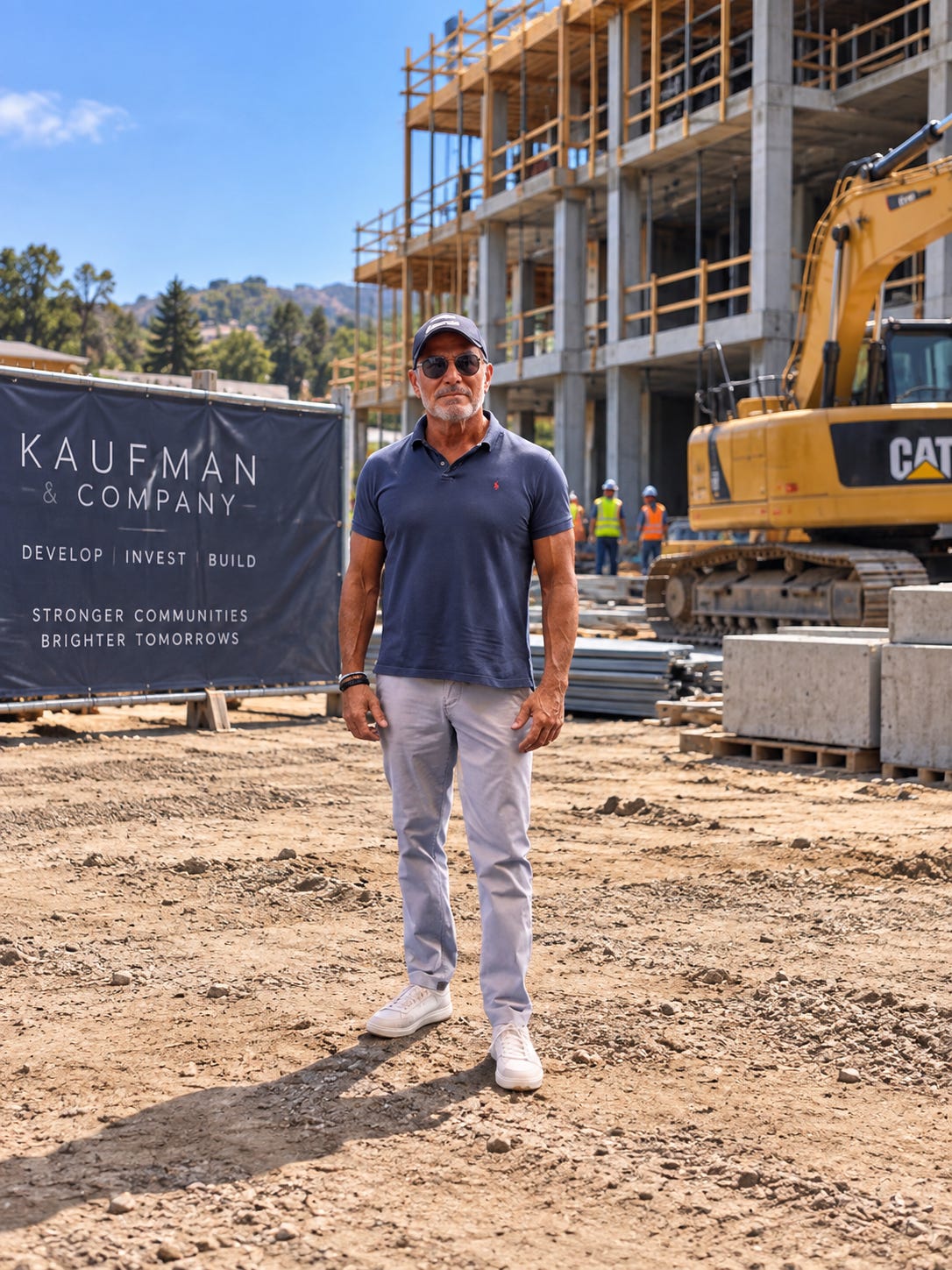
Daniel Kaufman is a real estate developer, investor, and founder with more than 25 years of experience across residential, commercial, mixed use, hospitality, workforce housing, and build to rent development. He has overseen more than $2 billion in project value and approaches real estate from the ground up, with a focus on site selection, underwriting, entitlement, construction, financing, and long term operations.
His investment philosophy is built around disciplined basis, durable demand, practical execution, and finding opportunities where market perception has not yet caught up with the underlying fundamentals.
Read more of Daniel’s work and follow his current projects at DanielKaufmanRE.com.