


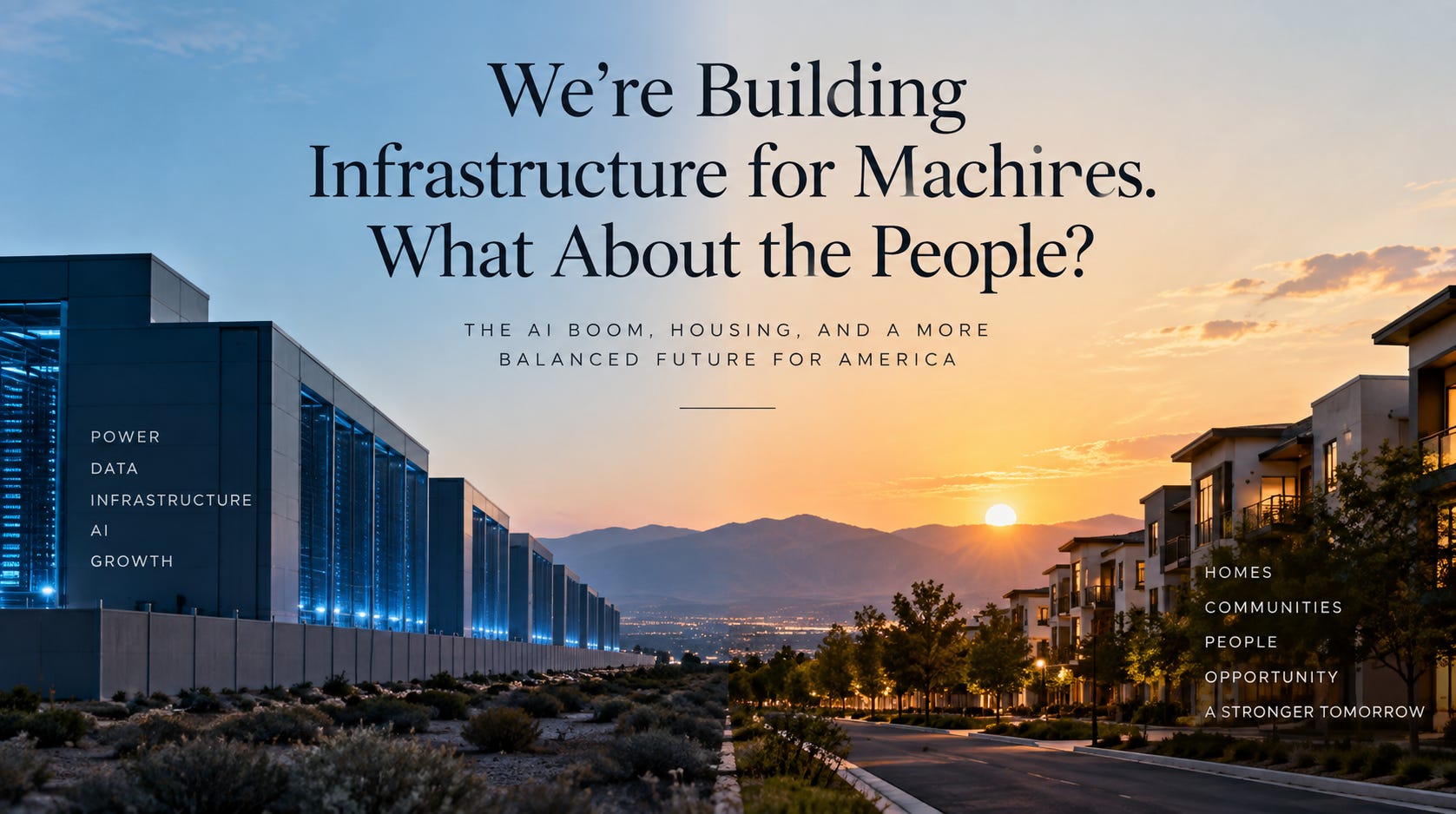
There is a strange thing happening in America right now.
We are preparing to spend extraordinary amounts of money building infrastructure for artificial intelligence while continuing to struggle to build enough places for actual people to live.
I don’t think those are separate conversations anymore.
In fact, I think one of the biggest opportunities in real estate over the next decade sits directly at the intersection of the two.
Housing.
Power.
Land.
Infrastructure.
Data centers.
Capital.
For most of my career, the real estate industry has treated these as separate businesses.
I’m increasingly convinced that is the wrong way to look at it.
The Numbers Are Getting Hard to Ignore
The AI infrastructure boom is no longer theoretical.
According to JLL, North American data center absorption reached a record 25 gigawatts during the first half of 2026.
That was double the level from a year earlier and roughly five times the level from two years earlier.
Vacancy is sitting around 1%.
Think about that for a second.
We spend a lot of time in commercial real estate talking about oversupply, vacancy, concessions and weak absorption.
Data centers have almost the opposite problem.
Demand is running ahead of the industry’s ability to deliver capacity.
And the capital behind this expansion is enormous.
JLL estimates roughly $700 billion of permanent financing could be required through 2028, with approximately $250 billion of AI related bond issuance occurring in the first half of 2026 alone.
But the number I find even more interesting comes from Lawrence Berkeley National Laboratory.
Its latest estimate suggests data centers could consume approximately 11.8% of total US electricity by 2030.
The range of possible outcomes is even wider, roughly 9.5% to 15.3%.
The reference case works out to approximately 649 terawatt hours of electricity.
That is not a niche real estate sector anymore.
That is infrastructure.
And infrastructure at that scale changes everything around it.
Now Look at Housing
At the same time, America continues to have a housing supply problem.
We can debate the exact size of the shortage.
Economists do.
What is harder to debate is why housing has become so difficult to produce.
Land is expensive.
Entitlements take too long.
Construction costs remain high.
Financing has become more difficult.
Insurance has become a larger consideration.
Municipal infrastructure is frequently inadequate.
Utilities can determine whether a project is viable before an architect has finished drawing it.
And increasingly, power availability matters.
Anyone who has actually tried to take a development from a piece of dirt through entitlement, financing, construction and stabilization understands this.
Real estate isn’t just about the building anymore.
It is about everything required to make the building possible.
That is where the housing conversation starts colliding with the AI conversation.
AI Has a Real Estate Problem
AI feels like a technology story.
Physically, it is also a massive real estate and infrastructure story.
AI needs servers.
Servers need buildings.
Buildings need land.
They need enormous amounts of electricity.
They need transmission capacity.
They need cooling.
They need fiber.
They need roads.
They need water in certain configurations.
They need local approvals.
They need construction labor.
They need financing.
And ultimately, the people who build, operate and service the surrounding economy need somewhere to live.
That sounds remarkably familiar to anyone who has spent a career developing real estate.
The difference is scale.
We are effectively building a new category of industrial infrastructure across America at a speed that many communities have never experienced.
And we are beginning to see the consequences.
The Backlash Shouldn’t Surprise Anyone
Here is perhaps the most important number in this entire discussion.
JLL reports that 79% of Americans support the United States maintaining leadership in artificial intelligence.
But only 14% support data center development in their own community.
That is a 65 point gap.
It tells us something important.
People aren’t necessarily rejecting AI.
They are asking a much more basic question.
What’s in it for us?
That is a fair question.
Imagine someone arrives in your community proposing a massive facility.
It may consume substantial electricity.
It may require new transmission infrastructure.
Depending on the design, water consumption can become an issue.
There may be generators, noise, construction traffic and visual impacts.
The project may receive incentives.
Then residents discover that once construction is finished, the permanent employment impact may not resemble that of a traditional manufacturing plant.
Why wouldn’t they ask questions?
The industry sometimes treats community opposition as an obstacle to development.
I think that is a mistake.
It is information.
Communities are telling developers that the old model of arriving with engineers, attorneys, an economic impact study and a request for approvals isn’t going to be enough everywhere.
And that is probably a good thing.
The Social License to Develop Is Becoming an Asset
Developers understand entitlements.
We understand zoning.
We understand permits.
But there is another entitlement that doesn’t appear on a zoning map.
The social license to develop.
You can have the right zoning, enough capital and a sophisticated engineering team and still discover that a community simply doesn’t want what you are proposing.
We are watching that happen with data centers across the country.
And I think the developers who solve this problem will have an enormous competitive advantage.
Not by creating better public relations.
By creating better projects.
There is a difference.
What If Infrastructure Investment Did More?
This is where I think the conversation gets interesting.
What if a major infrastructure development didn’t begin with:
How do we get this approved?
What if it began with:
What can this investment unlock for the community around it?
Maybe that means workforce housing.
Maybe it means electrical infrastructure that benefits more than one property.
Maybe it means roads.
Maybe it means schools.
Maybe it means public space.
Maybe it means tax revenue structured in a way residents can actually see.
Maybe it means local workforce development.
Maybe it means housing for teachers, nurses, first responders and the people working in the new economy being created around the project.
Not every data center needs an apartment community next door.
That isn’t the point.
The point is that we should stop thinking about infrastructure projects as isolated boxes.
This Is Where My Thinking Has Changed
I’ve spent more than 25 years developing real estate.
Residential.
Affordable housing.
Mixed income housing.
Build to rent.
Mixed use.
Hospitality.
Commercial.
And increasingly, modular construction and AI infrastructure.
For years, I thought about these primarily as different asset classes.
I don’t anymore.
I think they are becoming parts of an interconnected infrastructure system.
Housing requires land, utilities, entitlements, transportation, construction capacity and capital.
AI infrastructure requires land, utilities, entitlements, transportation, construction capacity and capital.
Different buildings.
Different economics.
Different operating models.
But much of the development DNA is surprisingly similar.
That realization has changed how I’m thinking about the next chapter of our business.
BUILD 2030
We have started calling this thesis BUILD 2030 inside Kaufman & Company.
It isn’t another fund.
It isn’t a new asset class.
And I don’t really think of it as a marketing campaign.
It is a framework for how we intend to look at development opportunities over the rest of this decade.
The basic idea is simple.
Infrastructure for people and infrastructure for AI should not be separate conversations.
Across our businesses, we already touch housing, development, construction, modular building systems, technology, investment and AI infrastructure.
The opportunity now is to think about how those pieces work together.
That may mean developing them together.
It may mean investing in infrastructure that enables housing.
It may mean using modular construction to attack development costs.
It may mean looking at smaller distributed AI infrastructure rather than assuming every solution needs to be hyperscale.
It may mean structuring community benefits differently.
And in some cases, it may mean deciding a project shouldn’t be built at all.
That last part matters.
Not every available site should become a development.
Not every community should host a data center.
Not every housing deal pencils.
And not every technological trend deserves unlimited capital.
Good development still comes down to disciplined underwriting.
There Is Another Risk Nobody Talks About Enough
AI infrastructure is attracting capital at extraordinary speed.
That should make developers more disciplined, not less.
I’ve lived through enough real estate cycles to know what happens when everyone decides an asset class can’t lose.
Capital arrives.
Underwriting gets aggressive.
Landowners adjust expectations.
Development pipelines explode.
People start underwriting tomorrow’s economics instead of today’s reality.
Then something changes.
The cost of capital.
Technology.
Demand.
Regulation.
Power pricing.
Politics.
Or all of them at once.
AI may transform the global economy and there can still be bad AI infrastructure investments.
Both things can be true.
That is why I believe the real opportunity isn’t simply to build more data centers.
It is to understand the infrastructure ecosystem around them.
The Developer of the Future Looks Different
For decades, specialization made enormous sense in real estate.
The multifamily developer built apartments.
The industrial developer built warehouses.
The hotel developer built hotels.
The utility handled power.
Technology companies handled technology.
Capital providers financed everything.
Those boundaries are getting blurry.
A development company looking at a site today may need to understand housing demand, electrical capacity, grid interconnection, municipal politics, construction technology, modular manufacturing, tax incentives, capital markets and AI driven demand.
That is a very different job description.
I think the best developers of the next 20 years will look less like builders of individual asset classes and more like allocators of land, infrastructure and capital.
The building will still matter.
But understanding what belongs on the land may matter even more.
America Doesn’t Need to Choose
There is a tendency to frame these conversations as tradeoffs.
AI or the environment.
Data centers or affordable electricity.
Growth or quality of life.
Housing or infrastructure.
I don’t think that is particularly useful.
America needs AI infrastructure.
It also needs housing.
It needs more power generation.
It needs transmission.
It needs modernized utilities.
It needs manufacturing.
It needs construction innovation.
And it needs communities willing to accept development.
The challenge is figuring out how those pieces reinforce each other instead of compete with each other.
That is partly an engineering problem.
It is partly a capital problem.
It is partly a political problem.
But it is also a development problem.
And development problems are solvable.
One Question I Keep Coming Back To
If we are about to spend hundreds of billions of dollars building the physical infrastructure required for artificial intelligence, what else can that investment accomplish?
Can it help unlock housing?
Can it modernize power infrastructure?
Can it create meaningful community benefits?
Can it support new forms of construction?
Can it leave a community stronger than it found it?
I don’t have all of those answers yet.
BUILD 2030 is partly about finding them.
But I am increasingly convinced that building infrastructure for machines while ignoring the infrastructure required by people is not a sustainable development model.
The next great real estate opportunity may not be multifamily.
It may not be data centers.
It may not be modular housing.
It may be understanding how all of them fit together.
And that is where we’re going to spend a lot of our time.
I’m curious how others see this.
If you’re a developer, investor, utility executive, local official or simply someone living in a community where data center development is being proposed, I’d like to hear your perspective.
Should communities expect more from the developers building AI infrastructure in their backyard?
I think they should.
About the Author
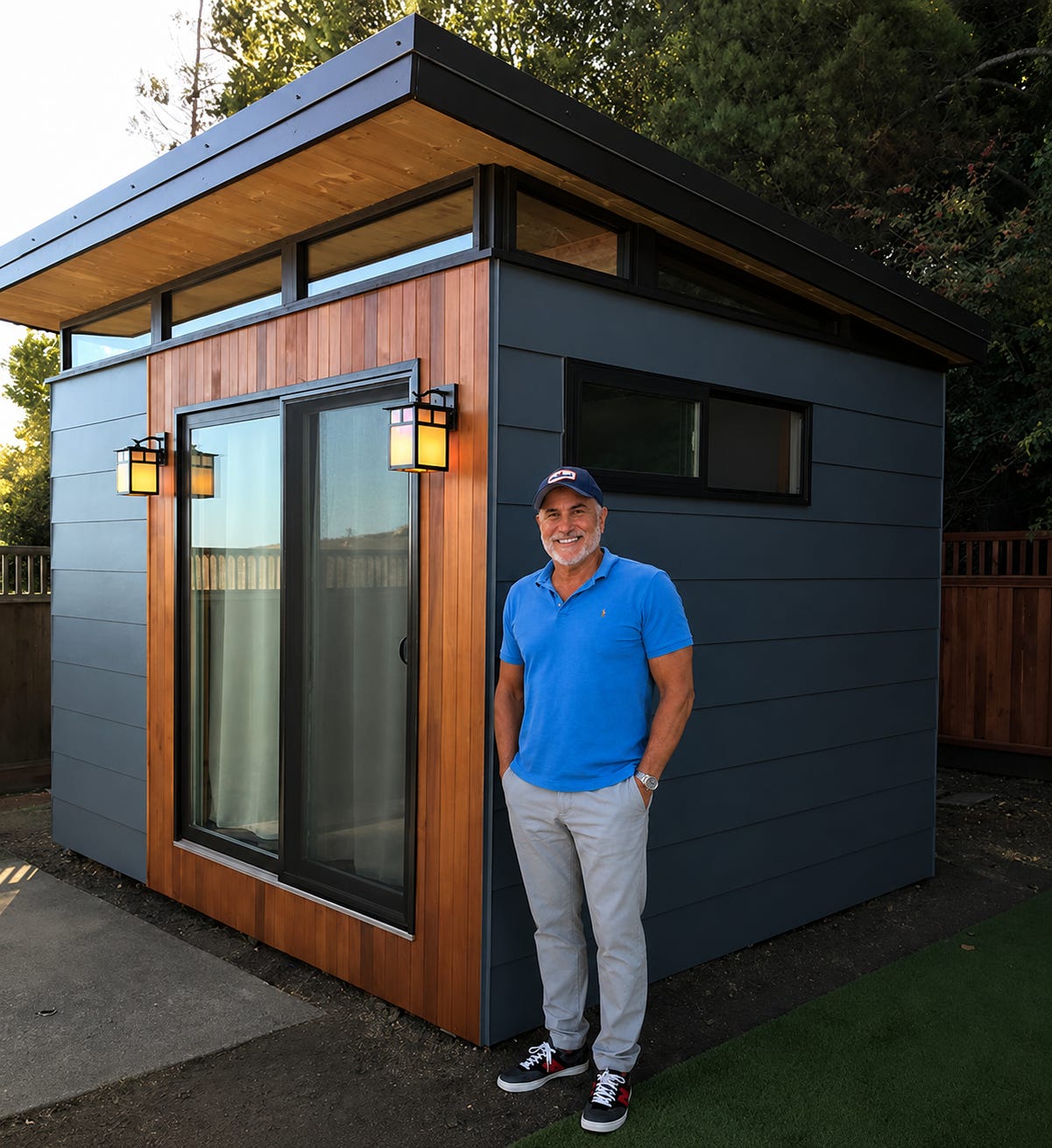
Daniel Kaufman is a real estate developer, investor and founder with more than 25 years of experience building and investing across residential, mixed use, workforce and affordable housing, hospitality and emerging infrastructure.
Over his career, Daniel has overseen more than $2 billion in project value, including more than 1,800 affordable and mixed income housing units and more than 2,200 market rate, hotel and mixed use units.
His approach is practitioner led. He has worked across the full development lifecycle, from land acquisition, zoning and entitlement through underwriting, financing, design, construction and long term operations. More recently, his work has expanded into modular construction and data center and AI infrastructure, with a growing focus on how housing, technology, energy, land and capital are beginning to converge.
Daniel writes about real estate from the perspective of someone actively building it. His work focuses on housing, development, capital markets, infrastructure, cities and the lessons that come from navigating projects through real world market cycles.
He believes good development should create durable economic value while also improving the places and communities around it.
Read more from Daniel at DanielKaufmanRE.com and DanielKaufman.info.